
The Great Content Rescue: How TYPO3 Turned a Massive Legacy Website Into a Future-Ready Platform
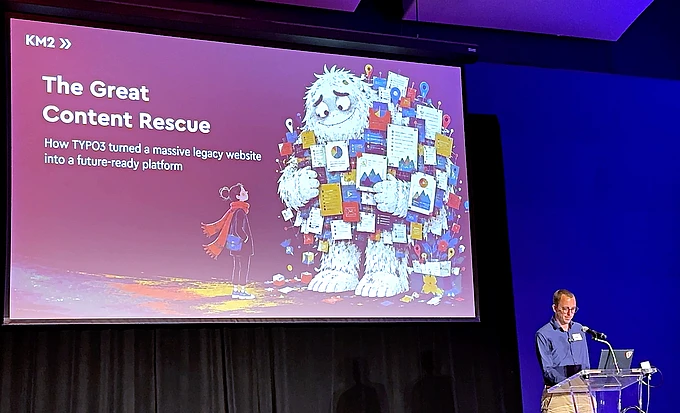
At the TYPO3 North America Summit, Kai Unterberg of KM2 >> showed how automated migration rescued 50,000 fragmented content elements on Gerresheimer’s website.

Introduction
Back in May, we were joined by a few of our partner agencies at the first TYPO3 North America Summit in Atlanta, Georgia. In the middle of the program, we reserved dedicated product demo slots for the agencies to showcase their products and work to show TYPO3’s capabilities.
One of those slots went to Kai Unterberg, owner of the Düsseldorf-based TYPO3 agency KM2 >>, who presented the relaunch of the international website of Gerresheimer, a global healthcare and packaging company. What started as a standard relaunch quickly turned into something much bigger.
A Website That Had Outgrown Its Structure
Gerresheimer wanted a modern digital presence and better user journeys, with TYPO3 remaining the foundation. But the site ran on an outdated TYPO3 version with a legacy codebase, served three languages, and needed new integrations, including HubSpot and six external data sources.
The real problem was hidden in the backend. Pages that looked like clear sections on the frontend were, in the system, loose fragments: a lone headline, a separate text, an image, a spacing element. Nothing connected them, so hiding one section meant selecting four elements, and design consistency suffered.
Automating the Rescue
With around 50,000 content elements in each language, restructuring by hand would have taken months, more than the editorial team or the budget could absorb. Instead, KM2 >> analyzed page types such as news, events and product pages, identified fragments that appeared together in a consistent order, and mapped those patterns to new, structured TYPO3 components. The content was then migrated automatically and reorganized in the page tree.
Better Structure, Better Journeys
The biggest improvement happened in the backend. Editors now work with meaningful components instead of juggling fragments, and the design team benefits from more consistent output. The project also changed how the team thinks about user journeys: they depend on content structure as much as on design. As Kai put it:
Design made it visible; structure made it possible.
For KM2 >> and Gerresheimer, launch day wasn’t the finish line but the foundation for continuous improvement, with new features and integrations added step by step. In Kai’s words:
TYPO3 helped turn content chaos into a platform for continuous evolution.
Watch Kai's Talk
Want to learn more about the project? Read the full case study or connect with Kai Unterberg on LinkedIn.
See You in Atlanta in 2027
We’re excited to announce that the TYPO3 North America Summit returns to the Georgia Aquarium in Atlanta on May 19, 2027. Whether you’re already building with TYPO3 or just curious about what it can do, we’d love for you to join us and meet the growing North American TYPO3 community.
Stay tuned for more updates.
