
From CMS to Content Intelligence: Fabian Stein on Enterprise Content at Scale
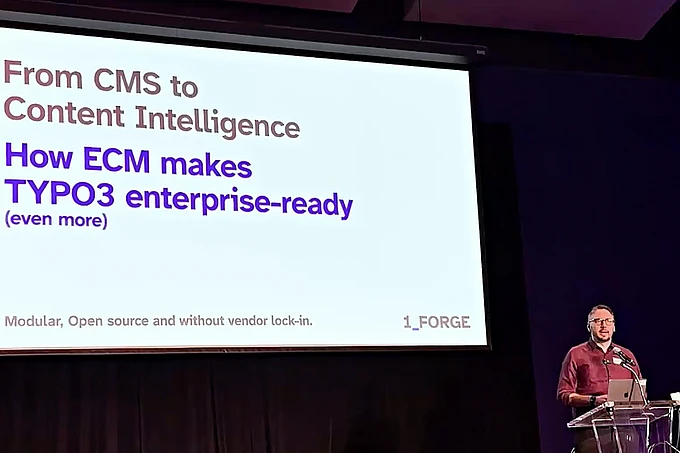
When hundreds of editors work across thousands of pages, do you really know what’s on your website? At the first TYPO3 North America Summit, Fabian Stein, CEO of punkt.de, explained why content is now operational infrastructure, and what it takes to move from content chaos to content observability.

Introduction
Back in May, we were joined by a few of our partner agencies at the first TYPO3 North America Summit in Atlanta, Georgia. Alongside the keynotes, we reserved dedicated slots for our partners to showcase their products and real-world work built on TYPO3.
One of those slots went to Fabian Stein, CEO of punkt.de, a digital agency based in Germany that has specialized in enterprise systems built on TYPO3 for nearly 30 years. He’s also one of the founding members of 1_FORGE, a joint enterprise network uniting three German TYPO3 agencies: dkd, sitegeist and punkt.de.
Fabian began by following up on the theme that content isn’t just editorial output anymore. Rather, it’s operational infrastructure and should be treated as one. Content now feeds websites, portals, search engines and AI-generated answers, and at this scale, Fabian warned, content becomes a business risk.
What works at 500 pages breaks at 50,000
Content management at an enterprise level isn’t a marketing team of three or four people where everyone knows what’s going on. Instead, it’s 300 or 500 people across different locations, all working on content across thousands of pages.
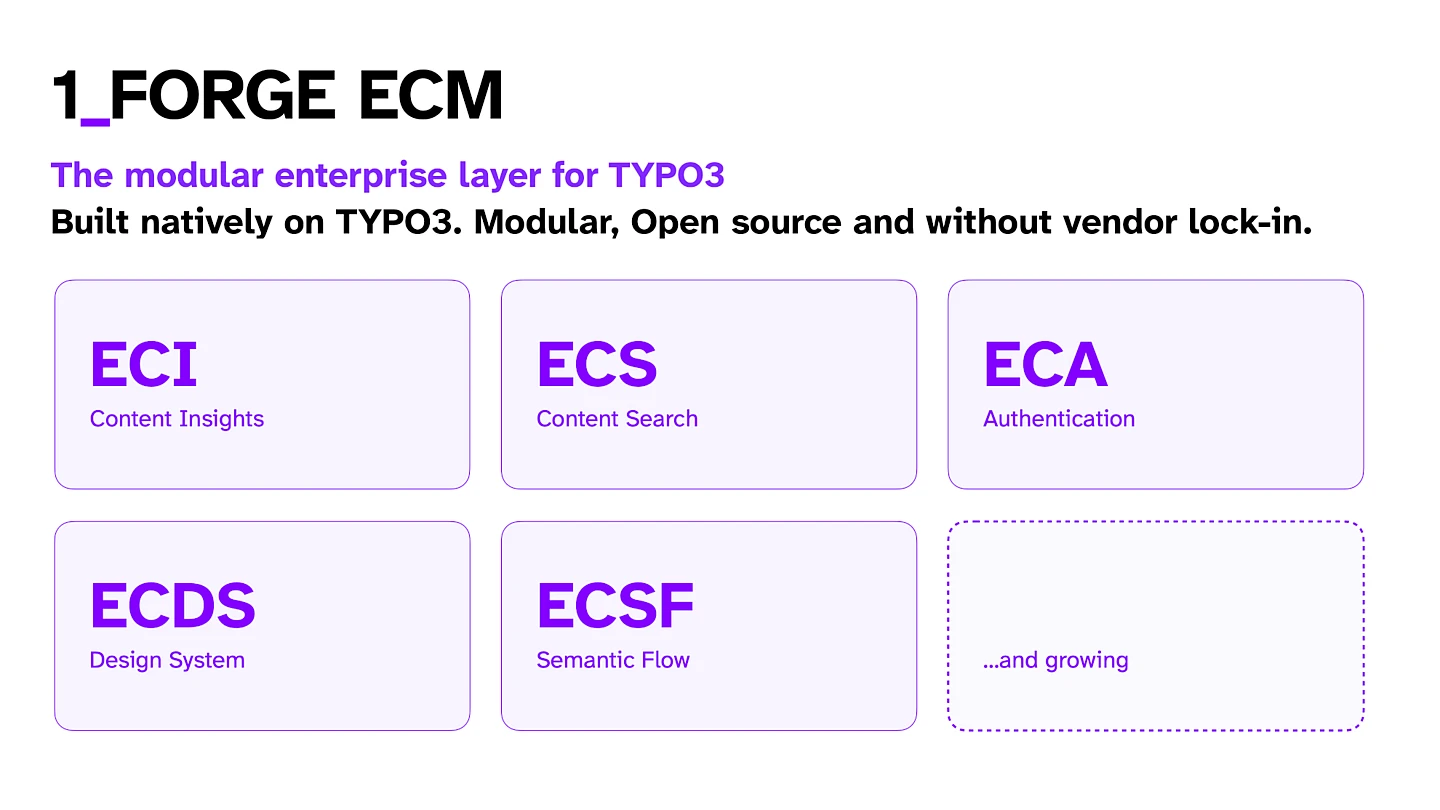
Fabian argued that enterprise content management exceeds the CMS itself. Although TYPO3 is a proven open-source enterprise CMS, the infrastructure around it matters too. As an example, he showed how 1_FORGE built an enterprise content management (ECM) layer on top of TYPO3. It currently has five modules, covering content insights, search, authentication, design systems and semantic flow. The rest of the talk focused on one of them: Enterprise Content Insights (ECI).
“Do you really know what’s on there?”
Fabian asked a rhetorical question: “When you have thousands of pages, the question is, do you really know what’s on there?” The honest answer is often no. Facts drift apart, content ages, and the same topic gets handled five different ways.
He illustrated this with an example from punkt.de. When rising energy costs forced the agency to raise its hosting prices, the landing page, a news article and a blog post each ended up showing a different price. Every price seemed right “until someone checks.” Today, Google and AI assistants pick up those figures too, so the inconsistency goes global.
The goal, Fabian said, is to go from content chaos to content observability, through visibility, rules and ownership.
Watch Fabian’s Talk
Enterprise Content Insights in practice
Fabian explained that one of their customers had 10,000 employees, 300 of whom were editors around the globe, serving different markets. Content was adapted and localized for each market, yet the overall relaunch was managed centrally from Germany.
Due to the complexity, it was hard for the central team to see which content elements were used where, and which countries were actively producing content. ECI was built to solve exactly this problem, and punkt.de now uses it on other large enterprise systems.
Fabian reiterated that the keyword when talking about content insights is transparency. He added that ECI is about automatic quality assurance and data-driven decisions, such as knowing which parts of a website receive the most editorial effort before deciding where to invest. It runs natively in TYPO3 and builds on the structure and metadata TYPO3 already provides.
Planned AI features include writing style analysis, reporting, LLM discoverability, and contradiction detection. For contradiction detection, Fabian pointed to his own company’s website, which variously says “20+ years,” “25+ years” and “since 1999.”
At the time of the talk, early access was planned for autumn 2026.
“Own the mess”
Fabian reminded attendees that you have to “own the mess” to find out where your system is lacking information and infrastructure. From there, you have to “own the stack,” so you can regain control of the system and get an overview of publishing and communication.
In his view, TYPO3 can be the entry point for enterprise content operations: extended rather than replaced, rolled out step by step, and without vendor lock-in.
He closed with a question for the room: “Where does yours break?”
See You in Atlanta in 2027
Want to learn more? Visit punkt.de or connect with Fabian Stein on LinkedIn.
We're excited to announce that the TYPO3 North America Summit returns to the Georgia Aquarium in Atlanta on May 19, 2027. Whether you're already building with TYPO3 or just curious about what it can do, we'd love for you to join us and meet the growing North American TYPO3 community.
Stay tuned for more updates.
