
Digital Accessibility: Why Companies Need to Act Now

Digital accessibility is becoming mandatory under the BFSG. Learn why accessibility is more than a technical task and how companies can implement it sustainably.


Introduction
Digital accessibility is becoming increasingly mandatory for companies. With the German Accessibility Strengthening Act (BFSG), the topic is gaining momentum—not only in the public sector, but also across parts of the private economy. In practice, however, accessibility rarely fails because of missing technical capabilities. Instead, it breaks down due to structures, processes, and unclear responsibilities.
This assessment is shared by André Richter, Director of Digital Experience at the TYPO3 Solution Partner queonext. In his day-to-day work, André supports organizations in designing and implementing accessible digital services and repeatedly observes the same patterns.
Legal Pressure Creates Awareness — But Not Solutions
The BFSG primarily acts as a catalyst. It forces companies to engage with digital accessibility. In terms of content, much of this is not new: for public-sector clients, binding regulations have existed for years under the BITV. What is new is the broader scope of the issue, and therefore its increased visibility.
In practice, this leads to a mixed picture. Some clients come with clearly defined accessibility requirements, while others only begin addressing the topic due to legal obligations. Accessibility is particularly prominent in environments connected to testing bodies, supervisory authorities, or formal audit procedures. In many private-sector contexts, by contrast, accessibility is still perceived as optional or secondary.
Articles & Press Releases

Why Accessibility Is No Longer an Option – But an Obligation
From June 2025, EU law mandates WCAG-compliant websites. Learn how OpenGemeenten ensures accessible, future-proof TYPO3 sites for all users.

T3CON24 Recap - Digital Accessibility: From Compliance to Business Value
Learn how to implement digital accessibility in TYPO3 projects, from technical requirements to business benefits. Prepare for EU accessibility laws while expanding market reach.
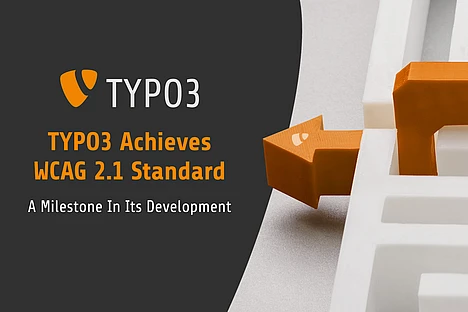
TYPO3 Instance Reaches WCAG 2.1 Standard Through BITV Test
The TYPO3 Bootstrap Package (frontend theme) is officially accessible after being tested by the German certification body BIK.

Accessibility Is More Than Technology
One of the most common misconceptions is reducing accessibility to isolated technical aspects—such as contrast ratios, ARIA labels, or formal compliance reports. These components are necessary, but they do not go far enough.
Accessibility also includes content-related and semantic considerations: plain language, clear structure, intuitive navigation, and consistent orientation. It does not only affect people with permanent disabilities, but also situational use cases—for example, poor lighting conditions, reduced attention, or mobile usage.
“Accessibility is not something you add later or enable at the push of a button. It has to be considered from the very beginning, across all disciplines.”
— André Richter, queonext
Where Accessibility Often Breaks Down in Projects
In many projects, a disconnect emerges between conception and operation. While the frontend may be implemented in a technically sound and accessible way, accessibility often fades from focus after launch. Content is added, modified, or migrated—frequently without clear editorial guidelines.
Particularly error-prone areas include:
- editorial content without a consistent structure,
- forms and self-service areas,
- video and multimedia content.
A technically accessible system only remains accessible if day-to-day editorial work adheres to the same standards. This is often where the formal responsibility of agencies ends—and with it, systematic quality assurance.
“Accessibility often collapses after content is added. A missing alt text or an unfortunate link is enough to make a site formally non-compliant.”
— André Richter, queonext
Automated Testing: Useful, but Not Sufficient
Automated testing tools are an important part of accessibility workflows. They help verify technical minimum requirements and identify issues early. On their own, however, they are not enough.
Accessibility cannot be fully assessed through automation. Semantics, comprehensibility, context, and usability always require human evaluation. The most effective approach is therefore a combination of automated checks and manual testing—ideally embedded in an ongoing process.
Accessibility as a Continuous Process
Accessibility is not a one-time state that can be achieved and then checked off. It is a continuous process that affects requirements, design, development, editorial workflows, and operations alike.
The earlier accessibility is embedded in requirements, user stories, and project planning, the more robust and cost-effective the outcome will be. Late-stage fixes, external audits, and correction loops often result in significantly higher costs than getting the concept right from the start.
A TYPO3 Perspective
The same applies to TYPO3: accessibility is not automatic. The system can be used to build both accessible and inaccessible websites. What matters is implementation, editorial usage, and awareness of relevant standards.
Current TYPO3 projects show that accessibility is increasingly shaping projects from the ground up. It influences structure, design, and editorial workflows in complex web platforms. Especially for large-scale and institutional sites, accessibility is being planned as a long-term quality factor—pointing toward a future in which accessibility becomes a standard component of professional TYPO3 implementations.
Accessibility Case Studies



Further Reading
This article is based on an in-depth conversation with André Richter on the Business Insights podcast. The full episode is available here, along with a complete English transcript available here.

