
TYPO3 vs. WordPress: Why Native Features Matter More Than Plugins
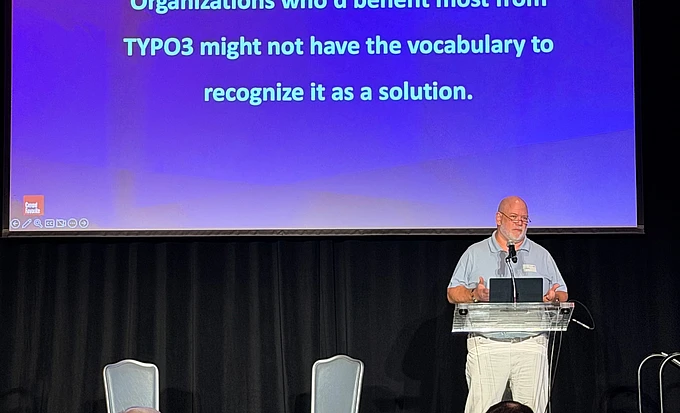
TYPO3 vs. WordPress isn't just a feature comparison. Our recap from the TYPO3 North American Summit explores why native multilingual support, workflows, permissions, and governance can reduce plugin complexity and improve long-term scalability.

Pat Ramsey, Director of Technology at Crowd Favorite, took the stage at the first-ever TYPO3 North American Summit with a talk originally titled WordPress vs. TYPO3. He quickly reframed it. Having built websites since 1995 and worked across WordPress, Laravel, Node, and everything in between, Pat's real subject wasn't a head-to-head comparison. It was a communication problem.
He set the tone by asking the question: how do you help people recognize a solution they don't yet have the vocabulary for?
The Foundation: Capabilities Built into the Core
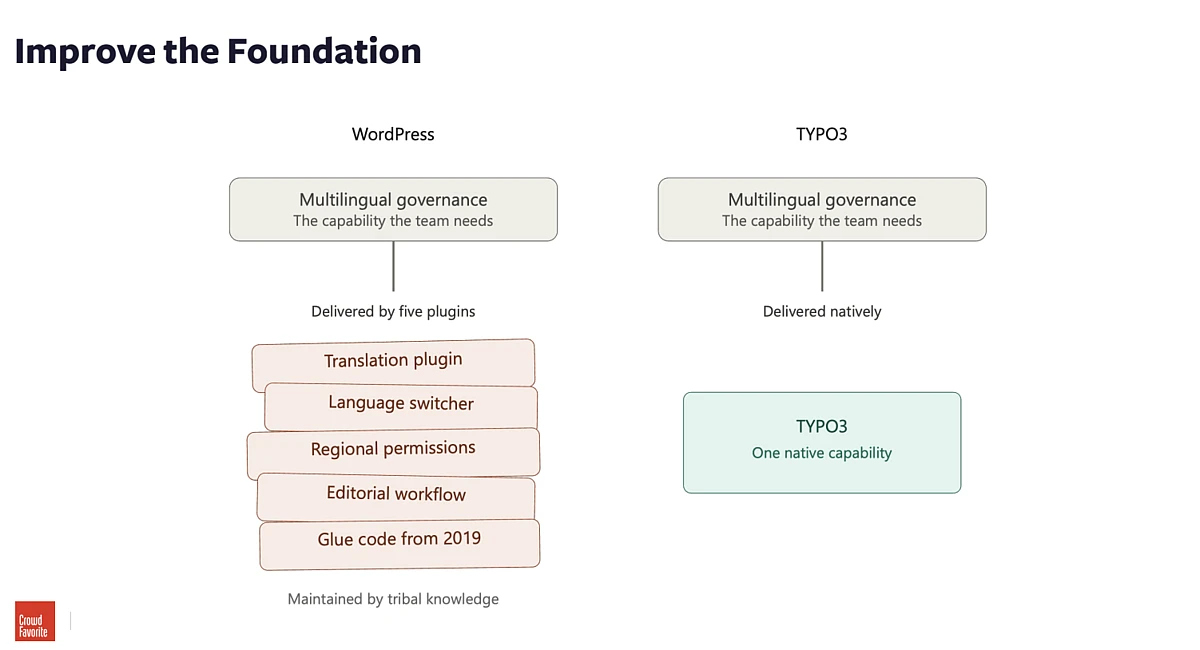
At the center of Pat's talk was a comparison of what a system delivers natively versus what it requires plugins to accomplish. This comparison is particularly relevant for enterprise teams evaluating CMS platforms and set the tone for his presentation.
Most notably, Pat revealed how WordPress, built around an extensible plugin architecture, often needs separate tools stitched together for multilingual support, editorial workflows, granular permissions, and governance — each maintained independently, each a potential point of failure. TYPO3, by contrast, ships with these capabilities built into its core.
That distinction, Pat argued, it's likely the crux of why organizations underestimate TYPO3 as an option.
Watch Pat's Talk
The Problem: A Vocabulary Gap, Not a Technology Gap
Pat’s claim is simple and straightforward. TYPO3 isn’t losing in terms of capability in the North American market, it’s losing on awareness. As he puts it, "organizations who'd benefit most from TYPO3 might not have the vocabulary to recognize it as a solution."
In the case of multilingual governance, TYPO3 delivers out of the box. Meanwhile WordPress requires teams to stitch together five separate plugins — a translation plugin, a language switcher, regional permissions, editorial workflow, and glue code accumulated over years — all held together by tribal knowledge.
Pat emphasizes this problem isn’t a technical failure per se, but rather an invisible cost that teams have normalized over time.
The Solution: Three Audiences, One Approach
Rather than a single pitch, Pat lays out three distinct conversations:
- The organization feeling friction they can't name: running a CMS bolted together with plugins, sensing something isn't working but lacking the language to diagnose it.
- The technical team with an internal mandate: already knows TYPO3 is the answer, but needs help managing the conversation upward — procurement, legal, budget, timeline.
- Long-term practitioners of other platforms: fluent in another CMS, facing a training and time problem, not a technical one.
Across all three conversations, Pat's advice is the same: fall back on requirements. Ask the questions. What's the goal? Where are you now? That gap becomes the conversation. He warns against leading with wholesale replacement, "the minute you start talking about replacing entire systems, people start freaking out," before anyone's even evaluated the case.
Better to soften the blow. Start with augmentation, let it become a migration over time.
For agencies and solutions engineers, his advice was direct. He encouraged allyship to the technical teams making that internal case. Produce the track record, the architecture, the proof for the conversation to move upward.
And that track record is real leverage. Pat underscores TYPO3’s advantage here, with roots going back to 1998. It's tested. It's well architected. And as Pat put it, that's worth leveraging on its own.
The biggest takeaway from Pat’s presentation? Don't lead with a technology pitch, lead with the gap. As he put it, this isn't a 15-minute answer — it's a questions conversation, not an answers one.
Author's note
While the comparison hook is strong, it's worth noting that neither this post — nor Pat's talk — is arguing that one platform is definitively better than the other. Each has its strengths, and this isn't a piece trying to settle which is the "better" solution. That question is too complex to answer simply, which is, in a way, exactly Pat's point.
