
TYPO3 v14.1—New Look, New Feel
The second sprint release of the TYPO3 v14 series comes with an awesome frontend theme out-of-the-box, further user interface optimization in the backend, a new module to generate QR codes, plus a range of updates and improvements.

As the new year gets underway and most of us are back in the office, routines are returning. But before things fully settle, there is one more reason to celebrate: the latest TYPO3 sprint release is here.
TYPO3 v14.1 introduces a ready-to-use default theme that enables you to launch new websites in minutes. The theme is fully self-contained, requires no third-party extensions, and showcases TYPO3’s standard page structure and content elements.
Beyond additional backend UI refinements, the sprint release also delivers a new backend module that allows editors to generate QR codes directly within the backend and link them to pages. With permanent URLs behind each code, this feature is particularly well suited for use with print materials.
Let’s take a closer look at these and other enhancements included in the new release. For deeper technical insights, please refer to the detailed v14.1 changelog.
Key Changes in TYPO3 Version 14.1
Default Theme “Camino”
One of TYPO3’s core principles is the clear separation between frontend and backend.
While TYPO3’s backend is available immediately after installation, the frontend must be built separately. For newcomers, this can add complexity, as developing a theme from scratch requires a solid understanding of TYPO3 internals and can take some time.
Addressing this challenge is a key focus of the TYPO3 v14 roadmap under objective 2: Themes, Standardization, and Best Practices.
With TYPO3 v14.1, a ready-to-use default theme called Camino is now included, enabling integrators to launch new websites within minutes. The theme is fully self-contained, free of third-party dependencies, and showcases TYPO3’s standard page structure and content elements that don’t depend on Fluid Styled Content. It also offers straightforward customization options, such as multiple color schemes and configurable navigation and footer layouts.
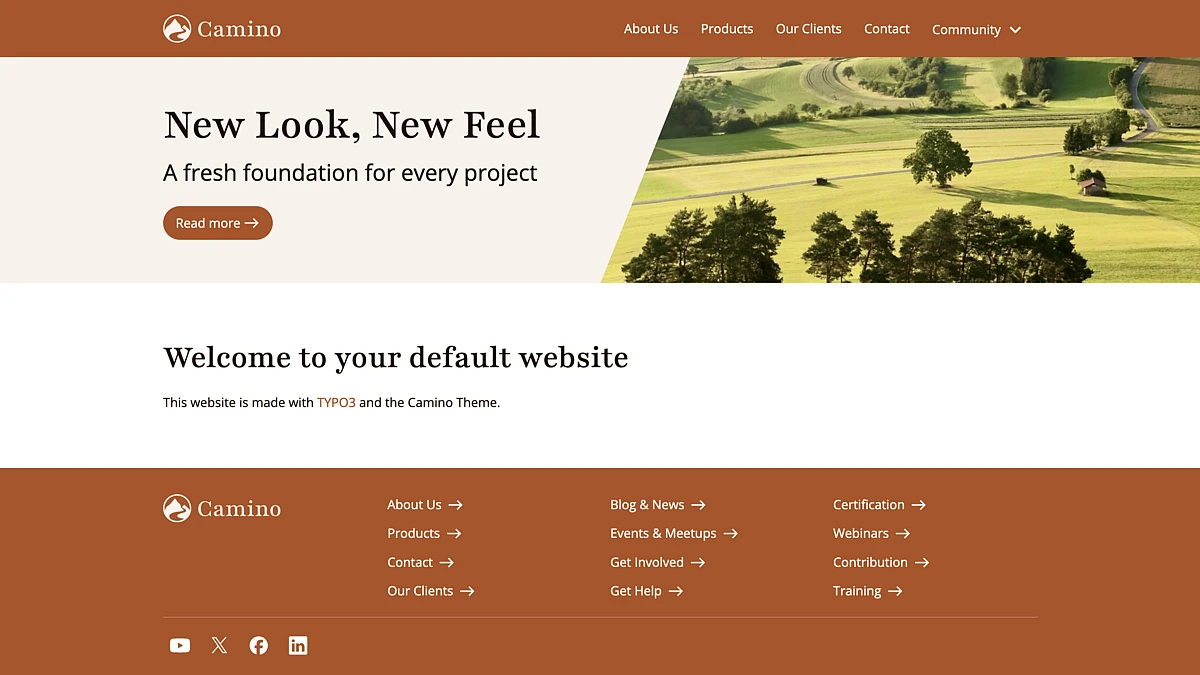

Delivered as an optional system extension, Camino keeps all resources encapsulated and does not interfere with existing setups when upgrading to TYPO3 v14.1. New installations enable the theme by default, and integrators can also activate it for new sites in existing environments as needed.
This approach allows us to develop a distinct theme for each new major TYPO3 release. For example, TYPO3 v15 could ship with a successor to Camino that highlights the new features introduced in that release. Camino itself marks the beginning of a great journey with TYPO3 v14.
Please note that Camino, in its current state, is not the final version of the theme. It will be further optimized, aligned with best practices, and designed for extensibility. When reviewing the system extension for your own development, please keep this in mind.
Backend UI Improvements
In TYPO3 version 14.0, we renamed, restructured, regrouped, and moved modules to create a more logical workflow.
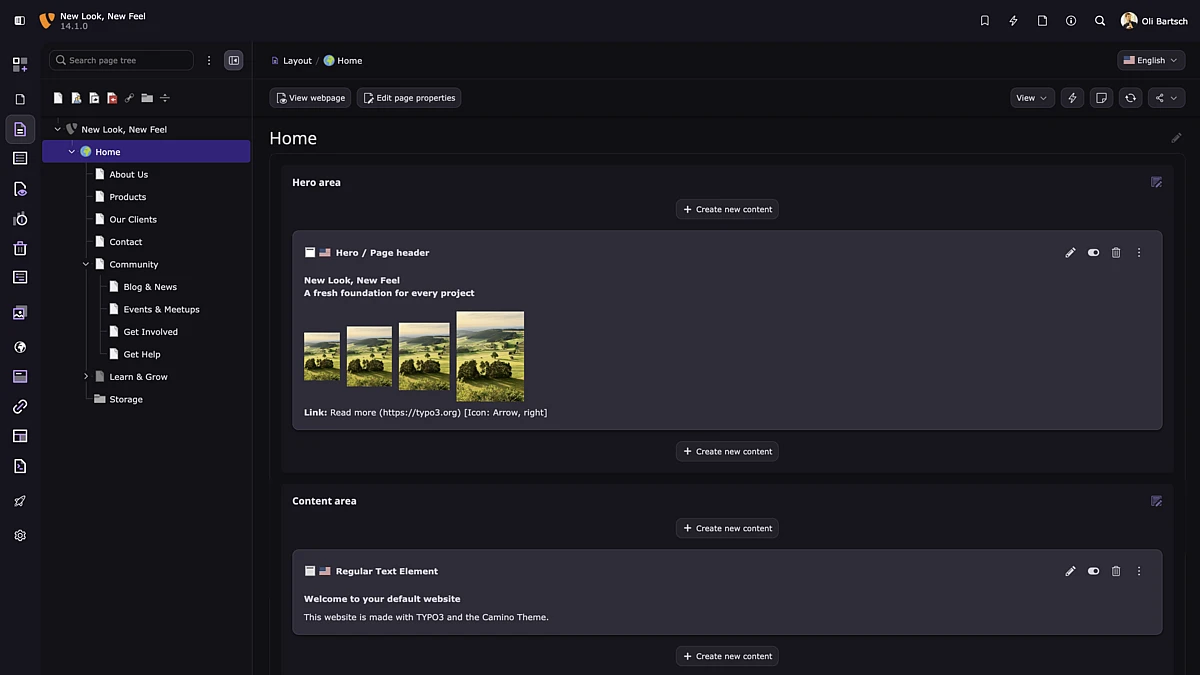
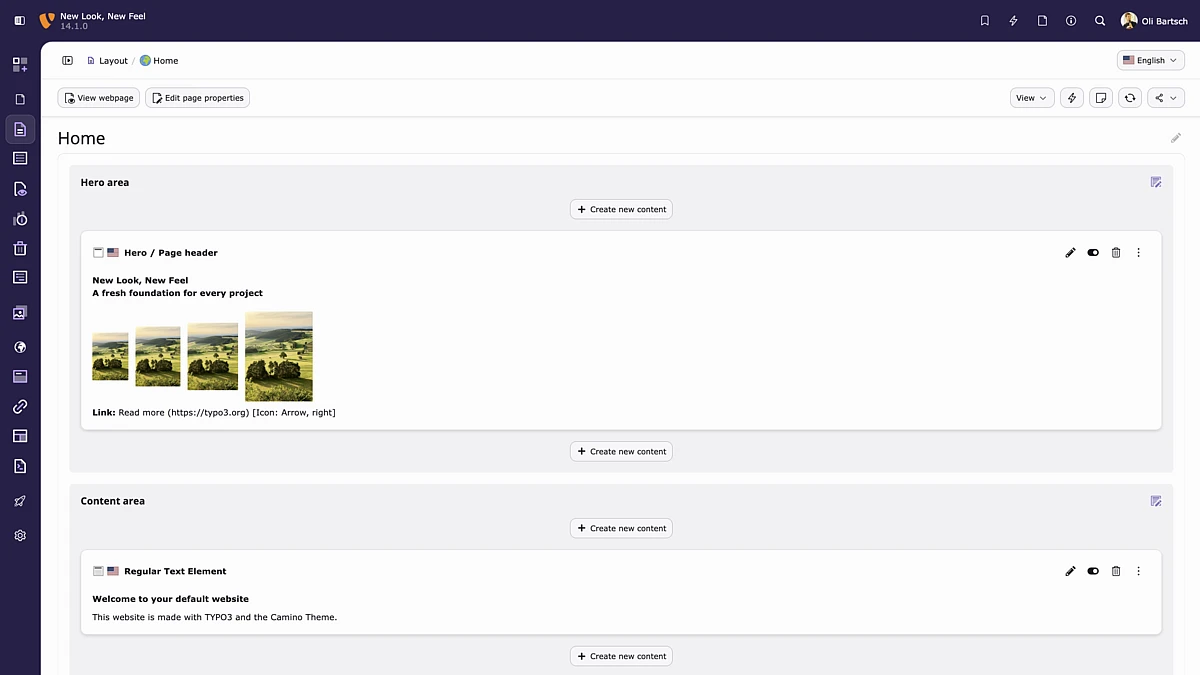
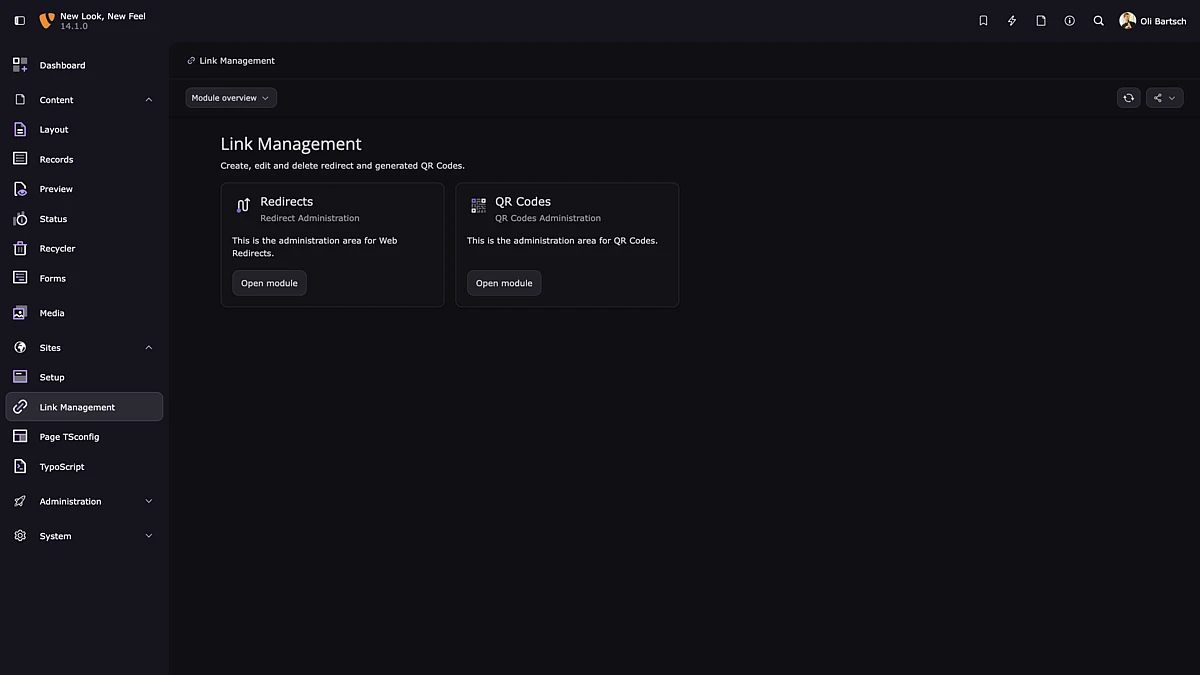
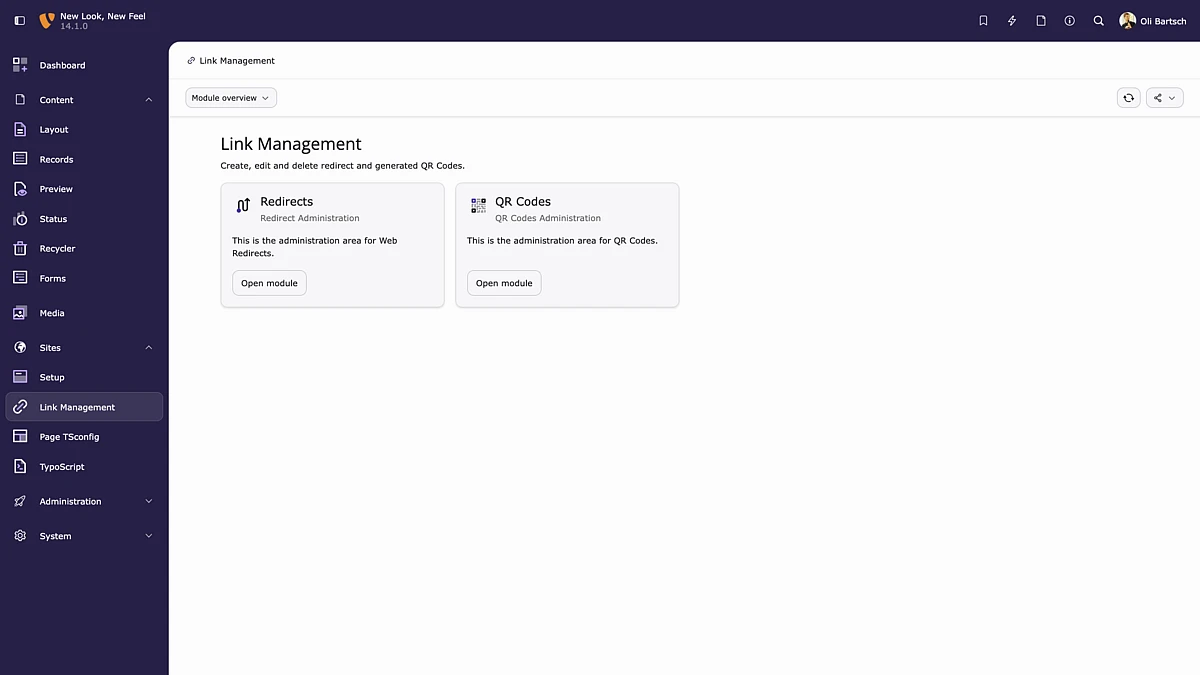
This work continues in version 14.1, further refining the interface and optimizing the visual appearance. The top bar features a new color scheme, consistent with the module menu on the left. You also find modern icons and rounded corners (almost) everywhere.
Quick Response Codes (QR)
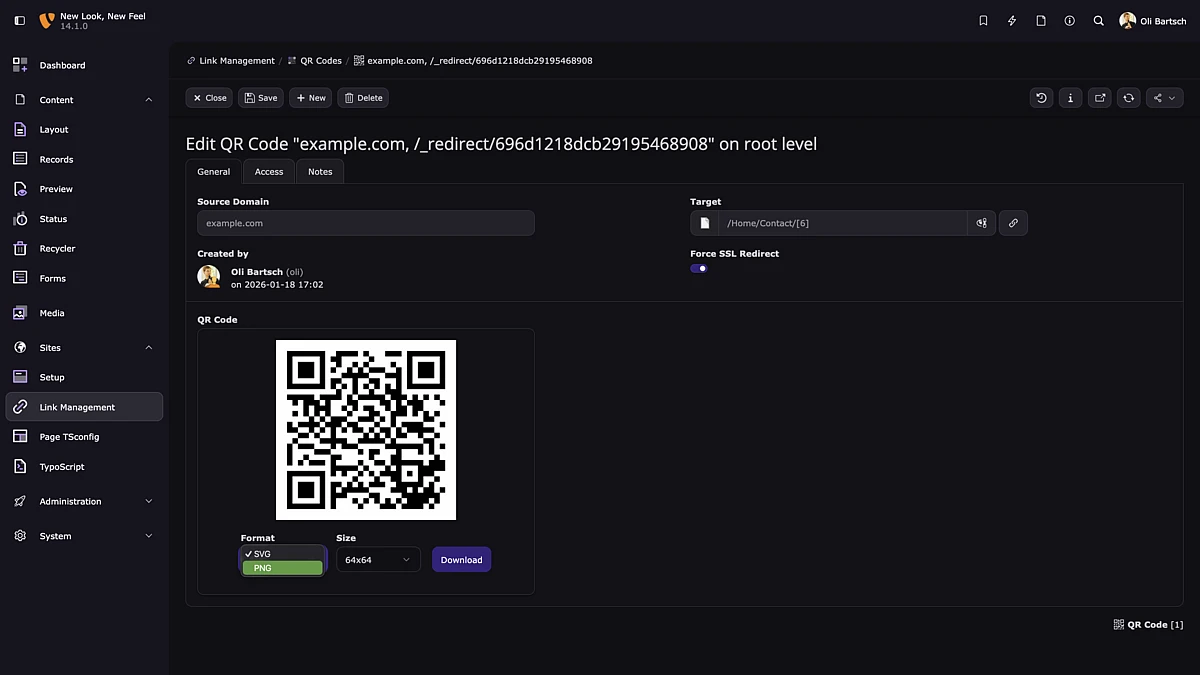
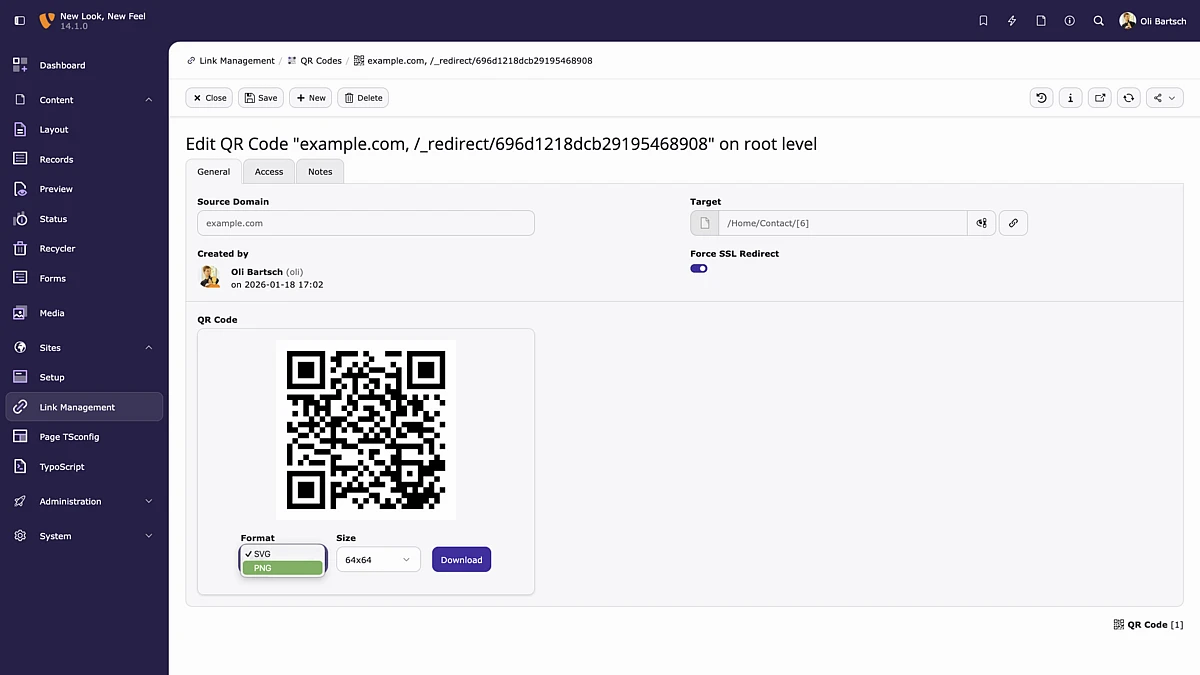
A new backend module allows editors to generate QR codes that represent unique, persistent URLs. These records can be linked to pages within the TYPO3 system and reassigned later as needed.
Because the URLs behind the QR codes themselves remain unchanged, the target destination can be updated at any time. This makes it easy to adapt campaigns, refresh content, or redirect traffic without operational disruption or additional production effort. As a result, printed materials such as promotional assets or booth displays remain valid and usable long term.
Under the hood, QR code records are implemented as a specialized form of redirects. This enables TYPO3 to leverage native features such as hit counters, enforced SSL, optional expiry dates, and other management capabilities.
The new module, grouped with the Redirects module under Sites → Link Management, offers an intuitive workflow and lets users download QR codes in PNG and SVG format, and various sizes.
By combining technical reliability with operational flexibility, the QR Code module delivers a solution for marketing campaigns, event management, and any situation where print materials need to stay perfectly aligned with evolving digital content.
Content Element Restrictions
TYPO3 enables integrators to define backend layouts that can include sections such as a header, main and secondary content areas, and a page footer.
TYPO3 now lets you restrict which content elements can be placed within each section of a layout. This makes it possible to prevent unsuitable content—such as large image sliders—from being added to areas like the page footer, and helps maintain a consistent look and feel across the site.
Derived from the well-known extension “Content Defender” by Nicole Hummel, this feature gives integrators more control over how pages are structured, and means editors are guided toward content choices that are consistent across the site.
Search in Translated Pages in the Page Tree
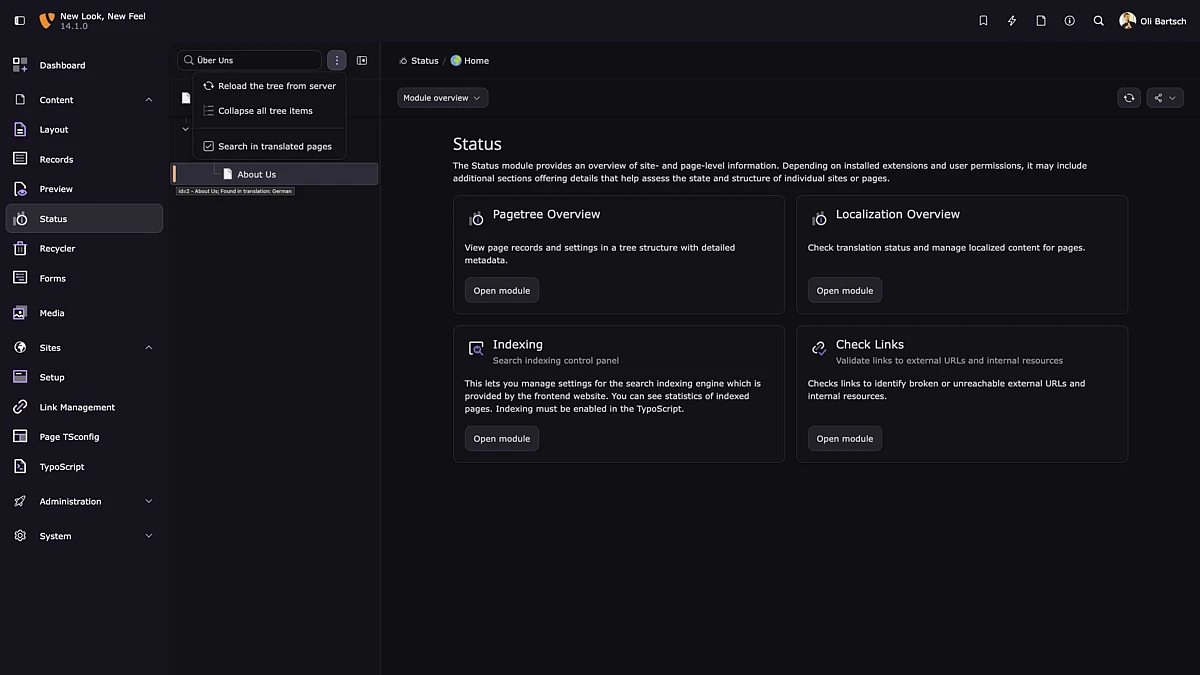
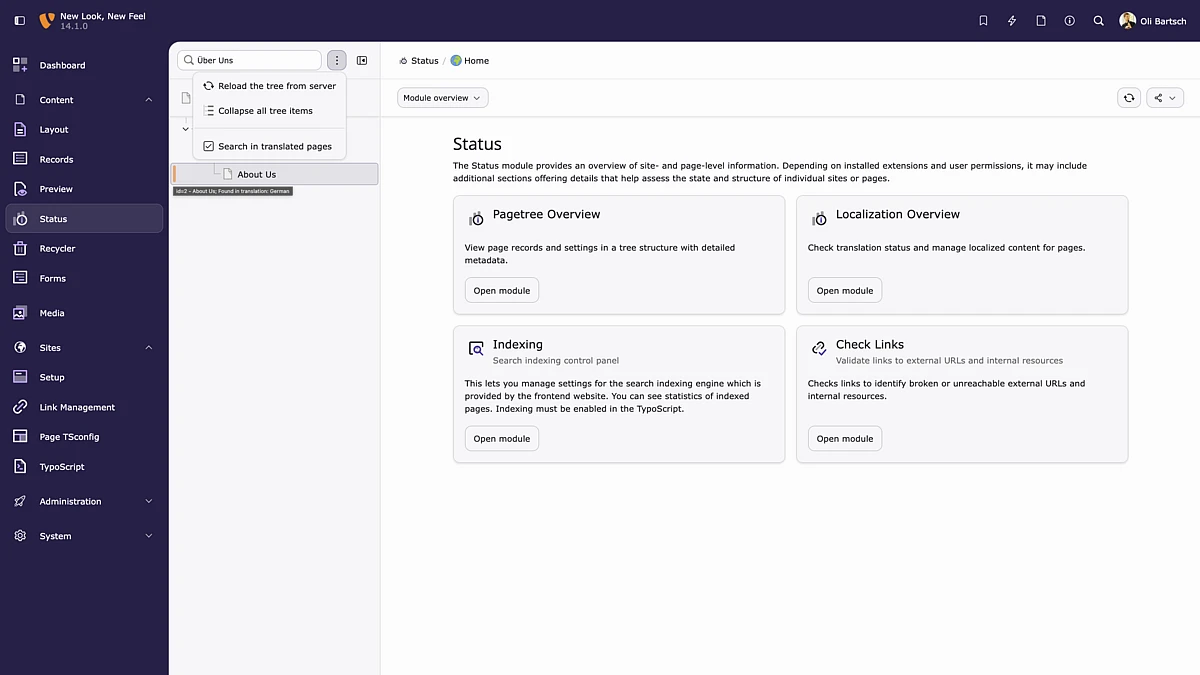
In multilingual TYPO3 installations, editors can now quickly search for pages using translated titles or translation UIDs. Visual labels highlight how each result matches the search, making it easier and more intuitive to navigate large and complex page trees.
The feature respects user permissions, including language restrictions from user groups, as well as workspace context, ensuring that only accessible translations appear in search results.
TYPO3 Under the Hood
Normalized XLF
All XLF translation files in the TYPO3 Core have been standardized using a unified XML formatter, ensuring consistent XML declarations, attribute ordering, and whitespace across the system.
As part of this clean-up, indentation has been updated from tabs to two spaces, aligning TYPO3 with Crowdin and PHP’s DOMDocument class formatting. Extension developers are encouraged to adopt the same standard. The included PHP script, xliffNormalizer.php in the “Build/” directory, makes applying this formatting quick and easy.
Fluid Namespace Registration
TYPO3 provides two possible approaches for registering ViewHelper namespaces. Namespaces may be imported explicitly within individual Fluid templates or defined globally for the entire installation.
For global registration, the variable $GLOBALS['TYPO3_CONF_VARS']['SYS']['fluid']['namespaces'] has traditionally been the default mechanism. Starting with TYPO3 version 14.1, a more structured and logical approach is available. Extensions can now register and extend global Fluid namespaces using a dedicated configuration file located at Configuration/Fluid/Namespaces.php.
The legacy registration via TYPO3_CONF_VARS remains functional for backward compatibility, but support for this mechanism will be removed with TYPO3 v15.
System Requirements, Support, and Maintenance
TYPO3 v14 requires at least PHP version 8.2 which will receive security updates until 31 December 2026. TYPO3 v14 also supports PHP versions 8.3, 8.4, and even the latest 8.5, paving the way far into the future.
We will support each TYPO3 sprint release (v14.0 to v14.2) until the next minor version is published. The long-term support version TYPO3 v14 LTS (aka version 14.3) will receive bug fixes until 31 December 2027, and we will provide security patches for TYPO3 v14 LTS until 30 June 2029.
Read more about the requirements and dependencies on get.typo3.org.
Download and Installation
You will find all the details about the release and how to download and install TYPO3 at get.typo3.org. Detailed installation instructions are documented in the Installation Guide. We recommend using Composer to set up your TYPO3 environment.
Feature Freeze Ahead!
The next milestone on our roadmap is TYPO3 version 14.2, scheduled on 31 March 2026. This release will mark the feature freeze for the v14 series. From that point to the final LTS release, the Core Team will focus on testing, polishing, and refinement. If you want to see your code contributions in TYPO3 v14 LTS, now is the best time to submit them (see the TYPO3 Contribution Guide).
