
Review the Proposed Rules for TYPO3 Units and the Unit Cooperation Panel
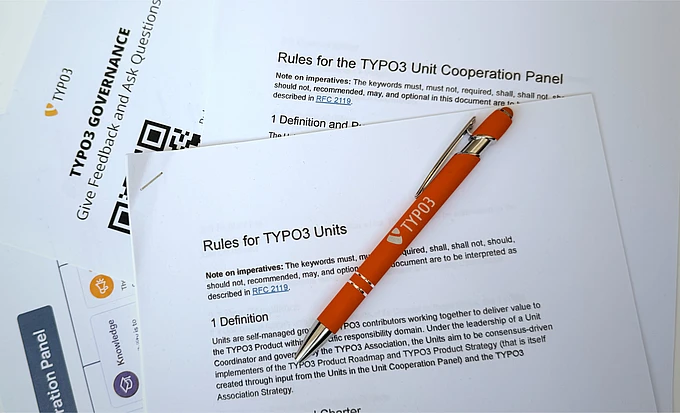
Proposed Rules for TYPO3 Units and a TYPO3 Unit Cooperation Panel are now available for community review. Questions and feedback are welcome. Read the proposals, consult the accompanying FAQs, and submit questions and feedback by 6 September 2026.

How should TYPO3 organize product development, collaboration, and coordination in the years ahead? Two new governance documents are now available for community review, and everyone is encouraged to read them, ask questions, and share feedback before 6 September 2026.
The proposed Rules for TYPO3 Units and Rules for the TYPO3 Unit Cooperation Panel describe a governance model intended to make collaboration clearer, reduce bureaucracy, and help contributors work together across the project. These documents supersede previous drafts and represent the current proposal from the Governance Working Group.
tl;dr
- Community review is open until 6 September 2026 for the proposed Rules for TYPO3 Units and Rules for the Unit Cooperation Panel.
- Read the proposals and FAQs, and submit your questions and feedback through the two GitHub pull requests. FAQs are included at the end of each document.
- The proposals introduce a new governance model with six Units and a Unit Cooperation Panel to improve collaboration, clarify responsibilities, and reduce bureaucracy.
- The documents were accepted by the Team Leader Meeting on 5 August 2026 as the basis for this public consultation.
- Community feedback will help shape the final rules. Unit Charters and the necessary TYPO3 Association Bylaw amendments will also undergo public review before the new governance model is adopted.
Reviewed by the Team Leader Meeting
Before being published for community review, both rule documents were presented to the Team Leader Meeting. After time to improve and give feedback on the documents, the Team Leaders present gathered on 5 August 2026 for a final feedback round. The leaders present accepted the text as the basis for this public consultation.
The Governance Working Group is now inviting the wider TYPO3 community to review the proposals. This broader review is intended to identify unclear wording, answer outstanding questions, and improve the documents before they are finalized.
Whether you are an active contributor, a team member, a committee member, or simply interested in the future of TYPO3, your questions and comments are welcome.

What Are the Proposed Units?
The proposal introduces Units as long-term responsibility areas for different parts of the TYPO3 project. Rather than organizing work primarily through individual teams, each Unit brings together related activities within a shared responsibility domain while remaining responsible for its own priorities and day-to-day work.
The proposed Units are:
- Feature
- Stability & Compliance
- Ecosystem
- Knowledge
- Content & Communication
- Community
The Community Unit is a new addition to the original proposal. It provides a common home for activities and committees that previously did not naturally fit into the original Unit structure, including Country Committees and other community-focused initiatives.
The illustration below provides an overview of the proposed structure, with example topics connected to each Unit. It does not show the cross-Unit collaboration that will also take place.
What Is the Goal of the Units?
The proposals focus on responsibilities within the Unit context. They intentionally avoid redefining other parts of TYPO3 governance. This follows the principle of separation of concerns: Each Unit should have clear internal rules while continuing to work within the broader governance framework of the TYPO3 Association.
The proposed Units aim to:
- Reduce administrative work for contributors — especially volunteers
- Enable Unit Members to support and mentor contributors, rather than doing the work themselves or manage bureaucracy
- Create clear areas of responsibility while encouraging cooperation
- Align work across the project through a shared roadmap
- Strengthen documentation of decisions, processes, and best practices
The proposals also recognize that ideas and expertise can come from anywhere. Unit Coordinators are responsible for coordination and prioritization, while Unit Councils provide a place for discussion, long-term thinking, and shared decision-making.
The Role of the Unit Cooperation Panel
The second proposal defines the Unit Cooperation Panel.
Rather than managing the daily work of individual Units, the Panel is intended to coordinate work across responsibility areas. It brings together representatives from every Unit alongside representatives from the TYPO3 Association Board.
Its purpose is to build shared commitment around common goals, strategy, and the product roadmap. At the same time, the proposal makes clear that not every decision needs to pass through the Panel. Units are encouraged to cooperate directly whenever appropriate.
One of the Panel's longer-term responsibilities is to establish clear processes for how ideas, initiatives, and contributions move from discussion into the TYPO3 product.
Two Documents, Two Discussions
The proposals are reviewed separately through GitHub pull requests.
Before submitting feedback, please read the extensive FAQs included at the end of each document. Many common questions are already answered there, and the FAQs also provide important background for understanding the proposals.
Building on Earlier Governance Work
These proposals continue the governance work from the past years. The goal is to create governance that is easier to understand, more transparent, and better suited to long-term collaboration across the TYPO3 project. For perspectives on why this governance process is necessary and the vision behind it, take a look at Stefan Busemann's article, Future-proofing Our Governance Together.
The proposed Unit structure represents one step toward that vision by defining responsibilities and accountability more clearly while preserving the collaborative nature of the TYPO3 community.
Questions Are as Valuable as Feedback
The rules will always be a work in progress and the Governance Working Group is looking for more than simple approval or critique. Questions and corrections are vital!
If something is unclear, if you see an edge case that has not been considered, or if you think a proposal could be improved, now is the right time to raise it. Community feedback will help refine both documents before they are finalized.
If you would like to discuss the overall approach rather than a specific rule, you are also welcome to speak with members of the Governance Working Group:
What Happens Next?
The publication of these documents is an important milestone, but not the final step in the process. Community feedback during this consultation will directly influence the final rules before the corresponding bylaw amendments are prepared and submitted to the Association membership.
Completing the Feedback Round
The current review period is an opportunity to improve the proposals before they become final.
Questions and feedback submitted through the GitHub pull requests will be reviewed by the Governance Working Group. Based on the input received, the rule documents may be revised, and the accompanying FAQs will be expanded to answer recurring questions and clarify areas that readers find unclear.
Proposing and Reviewing Unit Charters
The governance rules are only one part of the proposed framework. Each Unit will also have its own Unit Charter, defining its responsibility domain, delegated decision-making authority, initial membership, and any Unit-specific collaboration or reporting requirements. Before a Charter is adopted, it will go through multiple review stages, including a public community review announced on news.typo3.com. This gives contributors another opportunity to help shape how each Unit is established before it becomes operational.
Bylaw Amendments
Once the rule documents have been finalized, the necessary amendments to the TYPO3 Association Bylaws will be drafted and published for review. Those proposed bylaw changes will then be presented to the members of the TYPO3 Association at an Extraordinary General Assembly, where they will be put to a vote.
Deadline: 6 September 2026
Please submit your questions and feedback no later than 6 September 2026.
Every question, suggestion, and comment helps improve the proposals before they move forward.
Additional Background
The Unit concept attempts to solve underlaying problems that were uncovered as a part of the Association's strategy process. There are two foundational documents:
- The TYPO3 CMS Product Strategy, where need for restructuring is addressed in the Introduction (Product Development Governance) and as Goal 5 — Establish Governance.
- The TYPO3 Association Strategy takes on similar topics at a broader scale than the product itself. Especially 5.2 — Improving Governance and 5.4 — Strengthening the Innovation Process and Product Ownership
This section was added 20 August 2026, 15:00 CEST.
