
Generative Engine Optimization for TYPO3 | GEO Guide

Generative Engine Optimization for TYPO3 explained: Chunking, structured data, multilingual setup for citable AI answers. Our practical guide to GEO for content creators.

Generative Engine Optimization for TYPO3: Making Your Content Citable in AI Answers
If you take Generative Engine Optimization for TYPO3 seriously — that is, the deliberate optimization of content for generative AI answers — you need to understand how these systems actually work. In what's known as Retrieval-Augmented Generation (RAG), a query isn't matched against a ranking index but against a vector space, where content is stored as semantic fragments, or chunks. A chunk is a single, self-contained unit of meaning.
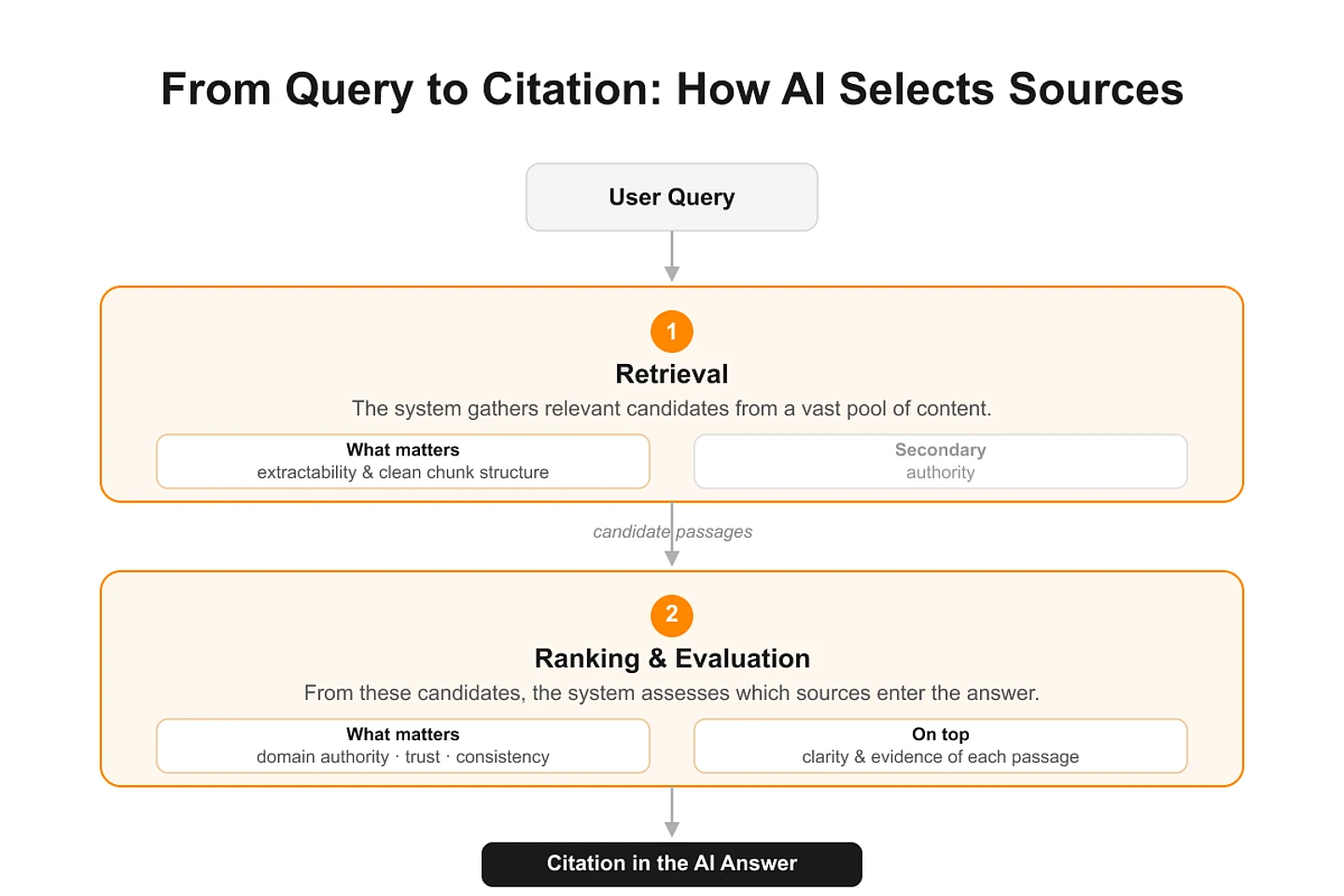
Two-stage diagram: AI answer systems retrieve candidate passages by extractability, then rank them by domain authority to select citations.*
Stage 1 — Retrieval: The system pulls relevant candidates from a vast pool of content. What wins here is the passage that can be most cleanly extracted as a standalone, verifiable answer.
Stage 2 — Selection and evaluation: From these candidates, the system assesses which sources make it into the answer. Domain authority, trust signals, and consistency all play an important role at this stage.
For organizations running a large TYPO3 project, this shifts the central question. It's no longer just whether a page ranks, but whether its individual content building blocks are structured and marked up well enough for an AI system to pick them up in the first stage — and then attribute them to your organization as a source in the second. This is where the architecture of the content management system (CMS) comes into play.
How GEO Differs from Traditional Search Engine Optimization
Traditional search engine optimization (SEO) targets ranking positions: a page should appear as high as possible in the results list. Generative Engine Optimization (GEO) — often referred to as AI search optimization — pursues a different goal. Here, the aim is for a large language model (LLM) to pick up your content, reproduce it accurately, and ideally cite it as a source.
The similarities are greater than they first appear: both disciplines require quality content and a clean technical foundation. The difference lies beyond that. With GEO, what matters isn't placement in a list but the citability of an individual statement — is the core message clear, is it substantiated, can it be understood without surrounding context? Anyone who sees SEO and GEO as opposites is making it too simple: one discipline builds on the other.
As a CMS, TYPO3 brings strong foundations to the table, because it supports structure, multilingualism, and semantically clean content — among other advantages that make the case for the CMS.
Chunk-Readiness Instead of Page Logic
It's no longer the whole page that counts, but the individual paragraph. AI systems break every document into small fragments and evaluate them separately. A paragraph that only works in context therefore offers little value — read on its own, it makes no sense.
What makes a passage extractable comes down to a few principles:
- The core message comes first, not at the end of a long build-up.
- References are resolved within the same paragraph, not across subheadings.
- Each paragraph forms a semantically complete unit.
For content modeling in the TYPO3 CMS, this means one thing in practice: cut your content elements so that each one makes sense on its own. The structured backend, with its individual content elements, actively supports this way of thinking, because it already organizes content into clearly delineated building blocks. Modern content models based on Content Blocks make semantically clean structuring even easier.
Multilingual Content: Where AI Systems Are Most Likely to Stumble
As long as a website is monolingual, chunk-ready writing is mainly a matter of discipline. With a multilingual website, it becomes a question of architecture. Retrieval systems have to recognize each language version as a distinct, cleanly marked-up unit. When they don't, two typical errors occur:
- Language mixing, where fragments of different languages blend together.
- Misattribution, where a model draws on the wrong language version as its source.
Preventing this takes three things: correct language markup at the markup level, a consistent separation of translation structures rather than blending them through fallback chains, and consistent terms and proper names across all languages. TYPO3's language handling provides the foundation for this, because languages are treated as standalone layers. But the foundation alone isn't enough — it has to be configured properly.
The Three Levers for Citability
When the content structure is right, three levers determine whether a language model correctly interprets and attributes content:
- Structured data. Using vocabulary from Schema.org, you give machines a clear classification: What is an article, who is the author, what is it about? Structured data is the most reliable bridge between your content and a system meant to understand it.
- Semantic linking and consistency. Terms, products, and proper names have to stay stable across documents and languages, so a model recognizes connections and doesn't treat two spellings as two different things.
- Authority and trust signals. Traceable authorship, substantiated statements, and factual consistency determine whether a system rates content as worth citing.
Implementing Generative Engine Optimization in TYPO3
In practice, GEO isn't a separate project but an extension of what good TYPO3 SEO already involves. The following points can be worked through step by step.
On the technical side:
- Maintain structured data centrally and output it across page types, rather than setting it manually per page
- Build templates so they deliver structured data automatically — via Site Sets, TypoScript or Extbase, and central rendering strategies
- Set up the language configuration so that each language version gets its own, correctly marked-up address
- Configure Site Configuration and language fallbacks deliberately, so no content slips into the wrong language — separation over convenience
On the editorial side:
- Write chunk-ready: keep each passage understandable on its own
- Put core messages up front, not at the end of a long build-up
- Resolve references within the same paragraph, not across subheadings
The two sides work hand in hand: the best technical markup does little if the content isn't written to be extractable, and the best text falls flat if no markup classifies it. This is exactly how we work at Friendventure on TYPO3 projects — pairing SEO, GEO, and development in one workflow, so markup and content reinforce each other from the start.
Conclusion: Start Small, Scale Iteratively
Generative Engine Optimization isn't a one-off task but an ongoing discipline. The pragmatic way in: start with structured data and chunk-ready content structure on your most important pages, and build out from there — rather than overhauling the entire website at once.
If you want to go deeper, a detailed overview of Generative Engine Optimization offers further context. For TYPO3 projects, the same holds true in the end as for good SEO: a clean foundation pays off in the long run — in traditional search results just as much as in the answers of language models.
