
Content is the Asset. Visual is the Skin.
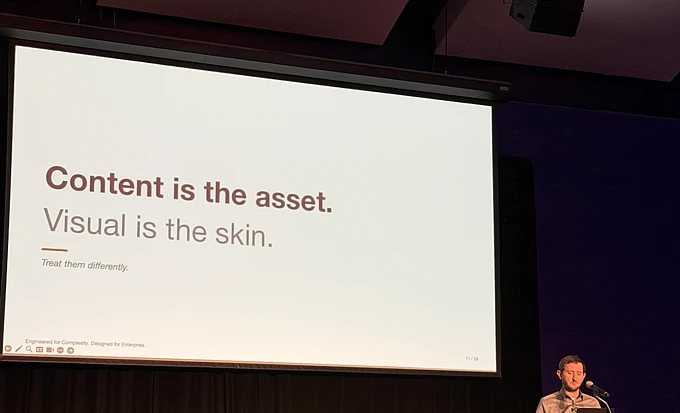
Benni Mack explored a hard truth about enterprise content management: the platform you choose isn't a five-year decision. It's a 20-year one.

Introduction
The first-ever TYPO3 Summit took place on May 19, 2026 in Atlanta, Georgia. Agencies and attendees from around the world gathered to meet and discuss open-source technologies, the state of CMS and the impact of AI on the industry. Benni Mack—the TYPO3 Core Team Lead and CTO of b13—showcased how TYPO3 is capable of handling enterprise-scale projects and came with noteworthy examples. His prominent, trusted voice in the TYPO3 community lent well to the minds in this room as he took a deeper dive into TYPO3’s vast capabilities.
Benni began where Karim left off. He presented the case for treating enterprise content management as a long-term, strategic asset rather than a disposable marketing function.
This requires us to take a look at the core problem.
The Core Problem
Benni opened with a familiar story—teams spending months tagging metadata by hand because the CMS doesn't understand metadata as foundational, rather a checkbox feature.
A recurring industry cycle was identified, one where organizations adopt new, “flashy” platforms (e.g. headless DXPs, AI-native tools, or page builders) with the haunting realization that they’ve treated their content as disposable.
What does this lead to?
Teams wasting time handling manual tasks. Vendor reliance. And a neglected content architecture.
It's what happens when a company treats content like a problem instead of an asset.
Watch Benni Mack's Keynote
The CMS Lie
Most CMS vendors are very good at one thing and politely silent about everything else, Benni pointed out. The CMS promise sounds expansive. Publish everywhere. Scale infinitely. Go headless. Go composable. Go agentified. But these promises obscure a deeper truth: they've designed the system for marketing departments and beautiful campaigns, not for the work of actually running a large organization.
Enterprise content demands discovery, governance, versioning, and trust.
The Enterprise Content Management Philosophy
Benni delved into the Enterprise Content Management (ECM) philosophy—a three-layer differentiator of the different functions of content architecture.
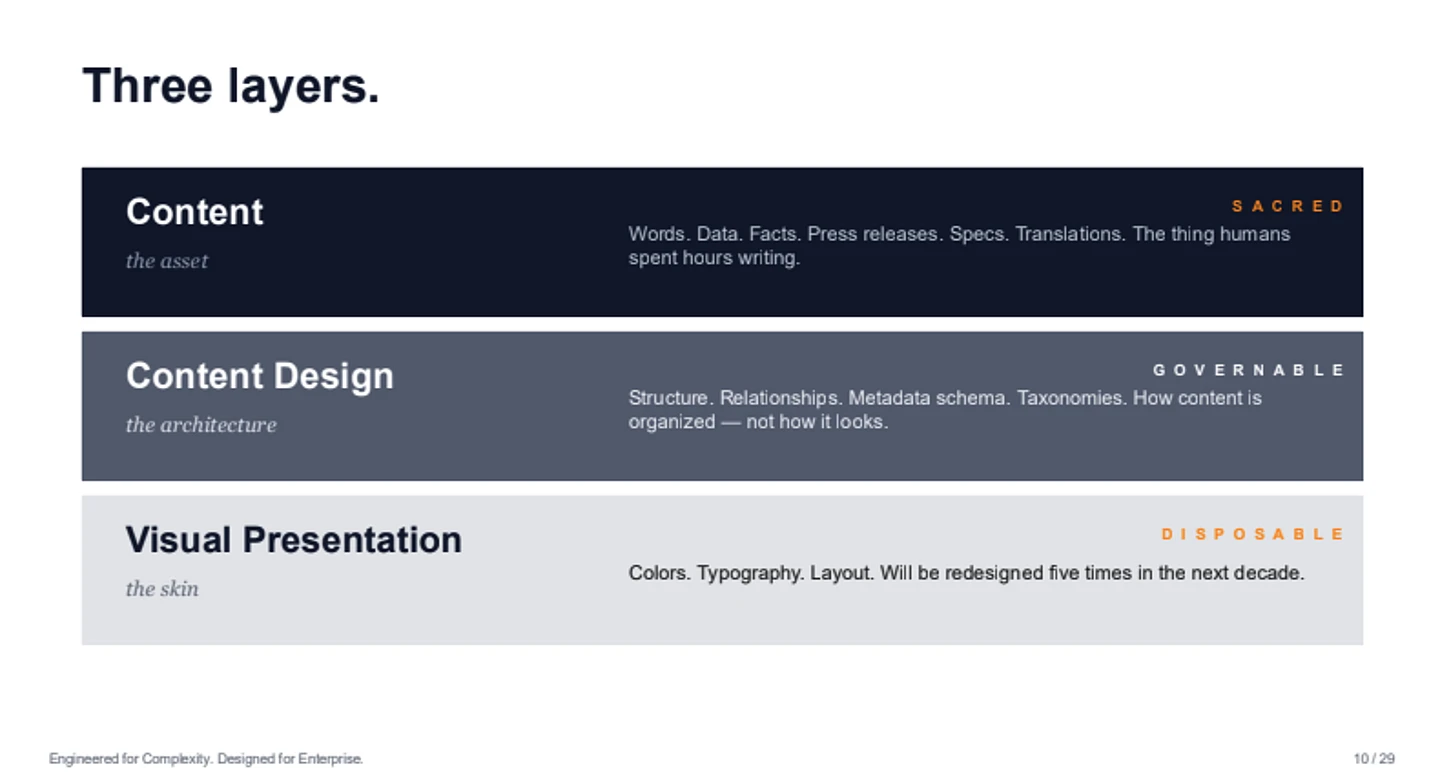
Layer one (The Asset)
Factual, human-created content that requires time and expertise for development.
Layer Two (Content Design)
The structure, meta schema, relationships and governance that create discoverability for content.
Layer Three (Visual Presentation)
The skin. The layout and design, the presentation element. While disposable and subject to iterations and redesigns, layer one and two must be treated as sacred and governable to ensure long-term value.
“Content is the asset and visual is the skin. Treat them differently."
The Unglamorous Essentials
Anchoring this point in the 18-month tagging project, Benni reinforced the issue wasn’t a need for more people, rather a system that understood metadata as a foundational concept. It's an integral component and metadata creates visibility for content and is translatable at scale.
In his presentation, he made something clear: permissions aren’t just a security feature. Permissions are an organizational design tool. In practice, this looks like 350 editors across 30 departments operating in nine languages. An ECM needs to adapt to who can publish, comment, or translate. And software support is vital for long-term stability.
Software support that thinks in decades, not quarters.
Most vendors sunset tools with six months' notice. The German equivalent of the USPS (Deutsche Post) built a custom tracking workflow on TYPO3 eight years ago. Three major version releases later, that unique 20% of their business still works without needing to negotiate with the vendor. A real ECM lets you build competitive advantage in the parts that matter to your business while the platform itself keeps upgrading beneath it.
Benni emphasized you’re not choosing between innovation and stability. You're getting both.
Flexibility, Not Replacement
TYPO3 doesn't ask you to choose between what you're already using and what you want to build. It sits behind your stack as a content backbone. Working with whatever your architecture demands.
This sounds abstract until Benni showed it in practice.
- A leading German cellular provider's stores use TYPO3 servers to retrieve information every day, with employees unaware of the infrastructure doing the heavy lifting.
- Eight thousand French train ticket machines ran on TYPO3.
That's the difference between a platform that wants to own your entire stack and one that respects what you've already built.
Villeroy & Boch: A TYPO3 Success Story
Villeroy & Boch, is a 277-year-old household name in ceramic dinnerware whose B2B portal has been running on TYPO3 for over 15 years.
At a glance:
- 277-year-old brand. Trust is the product.
- 40 countries
- 9 languages
- 10,000+ products
- One platform
“TYPO3 freed us to deliver a user experience without limitations."
Human Content is the Competitive Advantage
Benni brought the human element back into focus with a stark reminder that the web is filled with machine-generated content and in five years, most content will be non-human.
This brings us back to the point: the things humans actually write still matter. The things they discussed, fact-checked, legally signed off on becomes increasingly rare. This element becomes the asset competitors cannot replicate.
This is TYPO3’s competitive advantage. The platforms optimized for speed and scale and AI assistance will commoditize content. The platforms built to protect, govern, and archive human judgment will become strategic.
“TYPO3 is built for human work. Treat your human content like it matters, because soon it's the only kind that will.”
The 20-Year Decision
The platform you choose isn't a five-year decision. It's a 20-year one.
Your content is too valuable to be trapped in a system sold as a shortcut. It survives changes in leadership, agencies, and brands. The real question isn't whether you can afford to invest in the right platform. It's whether you can afford not to.
Additional Resources
- AI-ready is not a feature by b13 Gmbh
